
Choosing a subject#
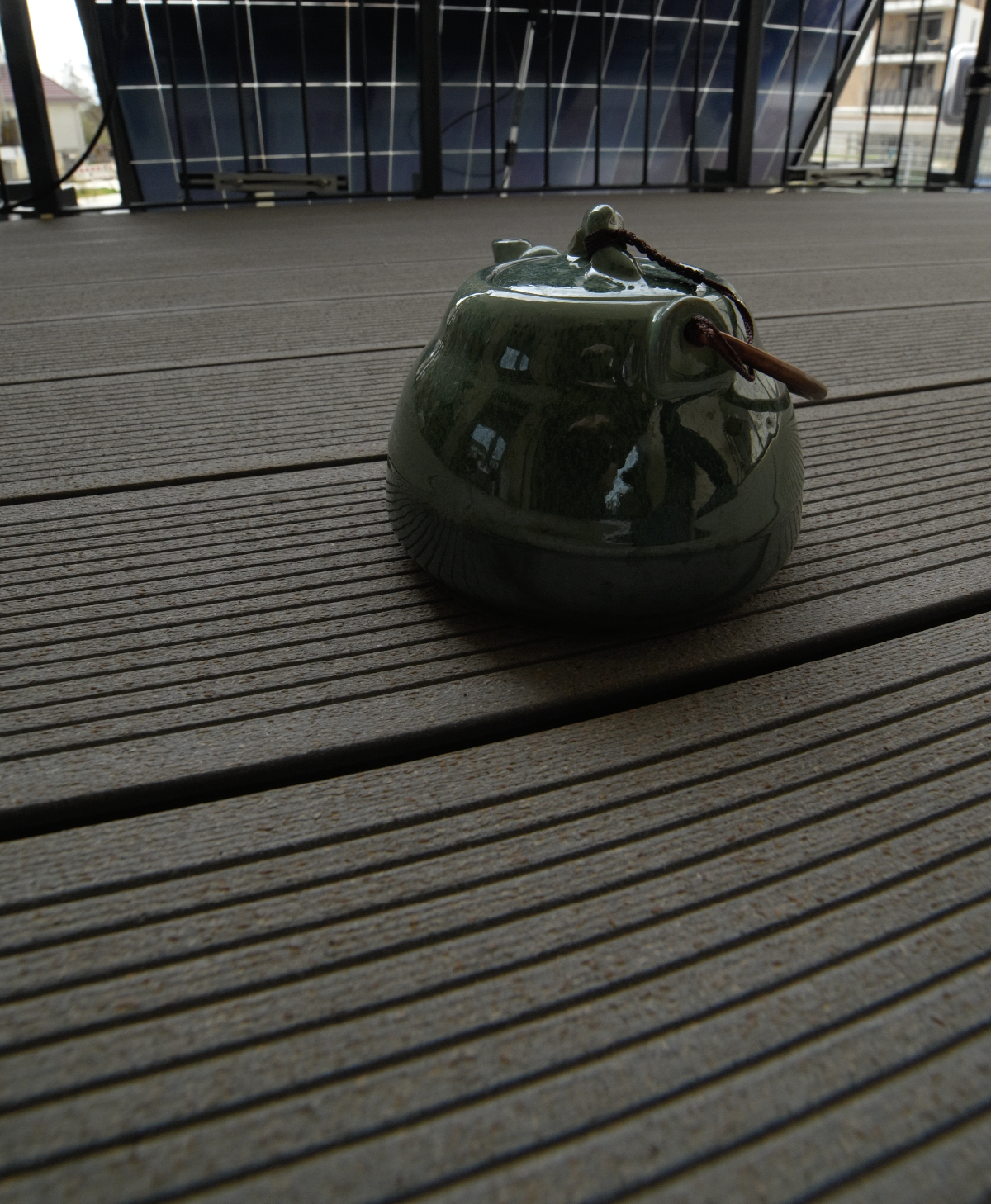
Your first splat should be as simple as possible: ideally an everyday object that you are very fond of. Scanning an entire room or a whole building is a bit too ambitious for a first attempt. Unless, of course, you already have video footage on hand, such as old drone recordings. I chose my teapot, which my girlfriend and I bought on vacation.
In addition, I had also dug up some old drone footage of a flight around the Göltzsch Viaduct in the Vogtland region of Saxony. Recordings like these are also very well-suited for experimenting.
Location#
The subject must be well lit. You also need enough room to walk around the object so that you can record video footage from all angles without obstruction.
Camera settings#
Set the exposure time as short as possible in order to reduce motion blur. For a first attempt, it should be 1/1000s or less. The aperture, if you have one, should be closed as far as possible. But be careful: most lenses become less sharp beyond a certain point due to the optical effect of diffraction. For my lens, this kicks in at around f/10.
The training process doesn’t use every frame anyway, so the frame rate can be kept low. Therefore, set the video resolution as high as possible and the frame rate as low as possible. In my case, that means 4K at 24fps.
Process#
Once the subject is in place and the camera is set up, recording can begin. Depending on the subject, you can film in either portrait or landscape orientation — the main thing is that you always have the entire object in the frame.
Now circle the object 360° as smoothly as possible. Once you’ve completed the first lap, repeat the process from different heights without interrupting the recording, in order to capture as many angles as possible.
After a few laps at varying heights, your recordings are already done.